

How to Find the RIGHT Wedding Photographer in Melbourne | 15-Year Expert Guide
Introduction
Selecting the right wedding photographer is often the first priority once a couple has secured their wedding venue. I’m William, a Melbourne wedding photographer with Tree Studio, established in 2009. Over the last 15 years, I’ve had the privilege of meeting more than 1,000 couples. I’ve listened to their love stories, discussed their detailed wedding plans, addressed their concerns regarding wedding photography, and tailored the perfect package for their individual needs.
A Focus on “Right”
Please note that throughout this article, I use the word “RIGHT”—not “best,” “perfect,” or other superlatives that might seem overpromising. I use “right” because my aim is to give the bride and groom practical guidelines to help them find the photographer who genuinely matches their wedding expectations, personal style, and, of course, budget.
What We Will Cover
In this guide, I will cover the following essential topics:
1. Methods for Finding Photographers: How to source candidate wedding photographers in Melbourne: online search vs. wedding expos vs. friend referrals.
2. Matching Your Style: How to find a wedding photographer whose work truly aligns with your personal preferences and aesthetic.
3. Budgeting and Booking: Strategies for booking the best possible wedding photographer while staying within your budget constraints.
4. Verification and Vetting: Key steps to confirm whether a potential wedding photographer is the right choice for you.
5. Key Questions: Essential questions to ask a potential wedding photographer before making your final decision.
6. Studio vs. Individual: The pros and cons of choosing a team/studio wedding photographer versus an individual photographer.
Table of Contents
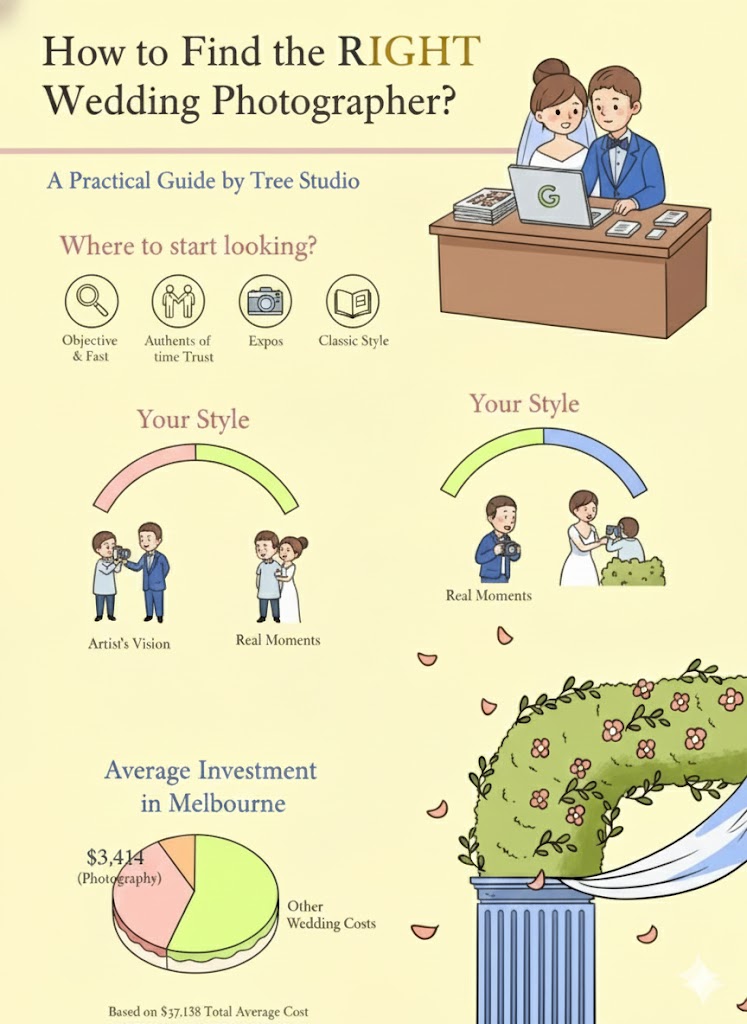
Methods for Finding Photographers in Melbourne
In this era of overwhelming information, couples have many avenues to encounter wedding photographer information, advertisements, and recommendations. Some methods are active, such as:
• Actively searching for a wedding photographer on Google.
• Asking friends who got married recently for their photographer’s contact.
• Meeting photographers face-to-face at wedding expos.
Other methods are passive, like being constantly exposed to wedding photographer posts and sponsored ads on your social media feeds.
A Rule of Thumb
If you are taking the choice of your wedding photographer seriously—and I assume you are, since you are reading this article—you need to shift your focus. Passive information on social media can be great for brainstorming, getting inspiration, and learning about current trends. However, these ads and social media bombardment should not be the sole triggers for such a crucial decision. Passive information is often disorganized and lacks the necessary verification regarding the photographer’s reliability or whether their pricing falls within your budget.
Let’s focus on the methods where you dedicatedly and intentionally gather information:
• Google, ChatGPT, & Gemini
• Diectory websites
• Friend Recommendations
• Magazine
• Wedding Expos
Let me analyze these four primary methods for finding the right wedding photographer in Melbourne.
Google, ChatGPT, and Gemini
Google’s Objective Judge
I must say that Google is a highly intelligent and objective judge when you type “wedding photographer Melbourne” into the search bar. As a Melbourne wedding photographer whose second role is marketing, I have over 10 years of experience with content marketing and extensive knowledge of Google’s ranking systems.
Google aims to provide the most trustworthy and helpful answers. This is why it remains the best search engine in 2025. When you see a website appear on page 1 (the 8-10 organic links, excluding ads), it usually meets several basic criteria:
• The website has been established for typically more than five years.
• Websites in the top 3 spots are likely to be over 10 years old.
• The business owners have to maintain an excellent scope of Google reviews.
When these website owners (wedding photographers) meet these essential metrics, Google grants them the opportunity to appear prominently. If you see a fresh website pop up on page 1 for a few days and then disappear a week later, it means Google is giving a new entry a chance to increase competition. However, Google’s final selection of 10 answers is meticulously chosen. Therefore, if reliability is one of your top considerations, you should place more weight on Google’s selection.
The Rise of AI: ChatGPT and Gemini
I admit I was hesitant about AI in 2023 when it first emerged, as the answers were not always accurate. But in 2025, AI provides much more accurate and targeted results.
While the top 10 wedding photographers on Google’s Page 1 can be generic, ChatGPT and Gemini offer a more personalized level of detail. You can ask for:
• Photographers specializing in a specific style (e.g., editorial, documentary, natural and candid).
• Photographers that fit a specific budget range.
• Even whether a photographer is familiar with your specific wedding venue and has shot a wedding there before.
Since Open AI and Google are investing heavily in AI development, the answers from ChatGPT and Gemini will only become more effective and personalized in the future. Let’s wait and see.
Wedding Photographer Directory Websites
Easy Weddings
- Established over 20 years, Easy Weddings is Australia-wide and remains one of the most dominant platforms. In 2025, there are 62 Melbourne-based photographers listed (down from 100+ a few years ago due to competition).
- Photographers here are generally affordable, reliable, and professional, often running as established businesses with standard workflows.
- However, Easy Weddings photographers are less distinctive—think of them as a Starbucks coffee shop: consistent, dependable, and accessible, but not particularly unique.
- If your priority is reliability, reasonable pricing, and multiple photographers, Easy Weddings is a solid choice.
Hello May Directory
- Hello May also operates as a traditional magazine but is highly editorial and selective when it comes to listing photographers. Photographers often wait 2–3 years on the wishlist before being accepted.
- The directory emphasizes storytelling, personal emotion, and authentic weddings rather than posed or luxury-focused events.
- Ideal for couples seeking indie, editorial, documentary, or artistically-minded photographers.
- If Easy Weddings is Starbucks, Hello May is more like a specialty coffee shop on Degraves Street: artisanal, unique, and thoughtfully curated.
Ivory Tribe
- Similar in style to Hello May, but less selective.
- More Melbourne-focused, making it easier for local photographers to join.
- Great for couples who like the Hello May aesthetic but want a slightly broader pool of photographers.
Other Alternative Directories
- Together Journal, Polkadot Weddings, and other directories tend to be international or interstate-focused. They offer editorial selection but are not Melbourne-specific.
The Lane & Vogue
- Both are very selective, but with a focus on modern luxury and urban-style weddings.
- Photographers featured here are magazine-level, highly polished, and specialize in high-end, stylish weddings.
- Perfect for couples planning lavish, extravagant, or fashion-forward weddings, but expect significant investment.
- If Easy Weddings is Starbucks, Hello May is Degraves Street coffee, The Lane and Vogue are like St Ali or Seven Seeds: premium, polished, and highly curated.
ABIA (Australian Bridal Industry Academy)
- ABIA operates differently from the above directories.
- It is couple-oriented and hosts annual awards judged by real brides and grooms, not industry professionals.
- Photographers recognized by ABIA may not fit a specific style (editorial, modern, documentary), but they are consistently reliable and loved by couples.
- If you want a trusted, bride-approved Melbourne photographer, ABIA is a worthwhile resource.
Directory | The “Vibe” | Who it’s For |
Easy Weddings | ☕ Starbucks | The classic, reliable, and budget-conscious couple. |
Hello May | 🌿 Degraves St Café | The indie, artistic couple who loves a good story. |
Ivory Tribe | 🏙️ Local Specialty | The chic Melburnian looking for local expertise. |
The Lane / Vogue | 🥂 St Ali / Seven Seeds | The modern romantic seeking high-end luxury. |
ABIA | ⭐ People’s Choice | The couple who prioritizes verified reviews and service. |
💖 The Power of Friend Recommendations in Choosing Your Wedding Photographer
A personal Friend Recommendation is often the most guaranteed and successful starting point for connecting with a potential wedding photographer. This method offers unparalleled insight and authenticity for several reasons:
🌟 The Authentic Experience
When you get a referral from a friend, you can ask about their complete experience, not just the wedding day itself. This includes:
• First Impressions: How the initial meeting went.
• Communication: The photographer’s responsiveness and how quickly they replied after the service was booked.
• Overall Satisfaction: The friend’s total contentment with the process and the final product.
• Viewing the Work: You can review all the images your friend received from the photographer, giving you an authentic look at their consistent output.
If you were a member of your friend’s bridal party, that’s even better—you already have first-hand experience working with this professional.
🚧 Why Brides Still Move Past a Friend’s Recommendation
Despite the obvious benefits, a referral might not always work out. Here are five common and valid reasons a couple might choose an alternative photographer.
Reason 1. Unavailability: The photographer is already booked for your specific wedding date.
Reason 2. Budget Constraints: The referral’s price is outside your financial plan. While unfortunate, you must move on to find a high-quality alternative that fits your budget.
Reason 3. Dislike of Style: You don’t connect with the photographer’s artistic style. Never force yourself to choose someone just because of a recommendation—your taste is paramount.
Reason 4. Experience Gap: The recommended photographer may lack experience with your specific needs. This could include unfamiliarity with cultural traditions like Greek, Lebanese, Indian, or Vietnamese weddings, or having no experience at your venue (e.g., Stone of the Yarra Valley, Werribee Mansion), where you prefer a photographer who knows the best photo opportunities and iconic spots.
The “Gut Feeling”
- The “Gut Feeling”: You just feel you are not Right with the referral wedding photographer, with no specific reason. Trust your subconscious. Your subconscious is so gifted and pre-emptive, and it will help you avoid making a wrong decision, no matter how eager your friend is to recommend a photographer to you.
- 💡 Industry Insight: One little industry secret I’ll reveal here: some wedding photographers will give your friend cashback or a referral bonus if they refer a friend to book their service. Not many, and I don’t assume your friend is recommending you to a wedding photographer for the sake of money, but it’s just in case.
- 📰 Magazine Features
You might feel that magazines are outdated and assert that paper media is dying. While I agree, to make this guide fair and unbiased, I still include magazines as one method to discover a wedding photographer.
Recommended Publications
I know there aren’t many dedicated wedding magazines available, but I suggest two publications you can easily purchase at a newsagency in Melbourne:
• Hello May: This publication also has a robust online version.
• Wedding and Bride: This magazine, belonging to the United Media Group, has been published for the Melbourne market for almost 20 years and operates as a family business. (In recent years, the United Media Group has extended its marketing to wedding expos as print magazine sales have decreased.)
Who Advertises in Print?
How do you find a wedding photographer advertised in a magazine? I have observed that the sponsored wedding photographers in print magazines are usually businesses that have been running for a very long time.
• Emerging wedding photographers tend to embrace new media, such as Instagram, TikTok, or Google Ads (which are more dominant).
• The photographers you find in magazines are often dedicated fans of print media. Some of these businesses have used magazines as their major marketing strategy for more than 10 years.
• The benefit here is that these established businesses are generally very reliable. If you prefer a more formal or classic wedding photography style, the photographers listed in wedding magazines are a good option.
Overall, searching through magazines should not be your main method for finding a wedding photographer in Melbourne, but rather a supplemental one.
- 🎪 Wedding Expos
As a wedding photographer myself, I often follow other talented photographers on Instagram for inspiration, and their unique images prompt me to browse their full portfolios online. The Value of Meeting In-Person
You know what? No matter how much time I spend looking at a photographer’s social media, website, or even LinkedIn profile, I get to know less about them than when I actually meet them at a wedding expo.
When I’ve walked around expos during quiet times, I’ve observed my peers. I can see:
• Their Style: Their choice of dress, their personal taste, and their manner of speaking.
• Their Personality: Whether they project an artistic feeling or possess a strong sense of humor.
I gain a much deeper understanding by talking to a photographer face-to-face—it’s far more effective than the cumulative time I spend viewing them online.
Benefits for the Couple
I imagine that if I were a bride, I would get even more value at a wedding expo.
• Efficiency and Verification: You can ask numerous questions and directly verify information with 10 or more different wedding photography companies on the same day. This feeling of effectiveness and straightforward comparison is awesome.
• Promotional Offers: Many Melbourne wedding photographers offer special promotions or discounts exclusively at the expo, which can help you save a considerable amount on your photography service costs.
• Assessing Style Fit: At the expos, you can see how different photographers decorate their stands. Some opt for minimalist style, while others choose a rustic theme. Observing their booth setting can instantly give you a sense of whether the photographer’s aesthetic truly fits your wedding style.
Although the trend since 2020 leans towards virtual meetings to save time, if you are a bride who takes seeking the perfect wedding photographer seriously, wedding expos remain one of the most effective methods.
The Credibility Hierarchy: Where to Find Your Wedding Photographer
When searching for a wedding photographer, the source of your information determines how much you can trust the results. Based on 15 years in the Melbourne industry, I have ranked the most common discovery methods by their objective credibility.
The Verdict: Google & AI > Friend Recommendations > Wedding Expos > Directory Websites ≈ Advertisements > Wedding Magazines
Why the Credibility of Each Source Varies
- Google & AI: The Large-Sample Credibility It may feel anti-intuitive to trust an algorithm over a human, but searching for a wedding photographer via Google or AI provides the highest level of objective credibility.
- The Logic: Think of this as a large-sample clinical trial. Google’s algorithm verifies a photographer’s credibility by analyzing 10+ years of business history, thousands of verified reviews, and consistent user engagement.
- The Result: It filters out the one-hit wonders and highlights professionals who have maintained excellence over a long period.
- Friend Recommendations: The Individual Credibility A friend’s recommendation is second on the list. While highly authentic, it relies on fortuity and a sample size of one.
- The Logic: Your friend’s vote is based on her personal experience, which was a unique event tied to her specific wedding day and venue.
- The Result: Because of your personal relationship, you naturally feel your friend has more credibility. However, a single positive experience is not as statistically reliable as the systematic verification provided by Google or AI.
- Wedding Expos: The Face-to-Face Credibility Expos are the most straightforward way to build your wedding photographer shortlist through direct interaction.
- The Logic: This is your chance for physical verification. You can instantly judge a photographer’s demeanor, sense of humor, and professional energy.
- The Result: It is the ultimate vibe check to see if this is the person you want by your side for 10 or more hours on your wedding day.
- Directory Websites ≈ Advertisements: The Commercial Credibility Directories rank fourth because their credibility is often tied to a marketing budget, not necessarily artistic skill.
- The Logic: Most directories function as paid catalogs. If a wedding photographer pays the premium fee, they get the top spot.
- The Result: Use these for inspiration, but always cross-verify their reputation on Google to ensure their credibility is real and not just purchased.
- Wedding Magazines: The Outdated Credibility Magazines hold the lowest credibility in terms of current reliability.
- The Logic: Magazines have a 3 to 6-month delay between layout and printing.
- The Result: By the time you see a wedding photographer in a magazine, the information is already old. They cannot offer the real-time updates or the most recent work that digital platforms provide.
Matching Your Style
After a few months of planning, you’ve booked your wedding venue and have a clear insight into your wedding theme and style. Now, you seek the Right wedding photographer who has the ability to capture your wedding day with an aesthetic perspective, represent your wedding day authentically, and reflect your personality and the endless effort you’ve put in over the past countless days.
There are many wedding photographers in Melbourne. Some have a very unique style featured on publications like Hello May, Easy Wedding, Vogue, Together Journal, and Ivory Tribe. Some wedding photographers are very famous in the wedding industry, their names are recommended by many wedding venues, their wedding look is very elegant, and their brides just look like models!
Some wedding photographers describe their style as natural and candid, some assert they prefer a documentary style, others say editorial, modern, or timeless. Okay, you feel overwhelmed—me too.
I am not here to lecture you on how to distinguish documentary wedding photography from editorial. I am here to help you find the Right wedding photographer in an effective and practical way.
Keep it simple. Don’t get overwhelmed by terms like “candid,” “documentary,” or “wedding photography.” There are only two types of wedding photography style:
1. Ego wedding photographer
2. Adaptation wedding photographer
Let me quickly explain:
• Ego wedding photographer means this photographer has a ** strong character**, and their wedding photography is captured from their perspective. the photos look like them.
• Adaptation wedding photographer minimizes their influence on the wedding photography and takes photos from your perspective. the photos look like couple.
Matching Your Style: Ego vs. Adaptation
We established that choosing the RIGHT photographer involves a philosophical choice: Ego (Photographer’s Perspective) vs. Adaptation (Your Perspective).
Below is an analysis of the pros and cons, and how clients approach this fundamental trade-off of “Control” vs. “Risk/Reward.”
1. 👑 Ego Wedding Photographer
This photographer is an artist with a strong personal style; they treat your wedding as part of their creative body of work.
👍 Pros (Value to the Client)
1. Niche Artistic Sense (Masterpiece):
o They possess a very niche artistic sense.
o You can expect your wedding photography to be an artwork, where you and your wedding day are integral parts of their masterpiece.
2. Expert Direction and Control:
o They are experts at giving clear direction to the bride and groom, ensuring you look like a fashion model.
o They excel at controlling light, flash, and composition; they can control everything in the frame.
o If you expect “WOW” kinds of wedding photos to share on social media, they are an excellent option.
👎 Cons (Risk to the Client)
1. Over-Polishing and Lack of Authenticity:
o You might feel your wedding day is over-polished. You may find you look more like a model in a Vogue magazine than your authentic self.
o Your wedding photo might not truly reflect your raw emotion on the wedding day, but rather resemble an artwork displayed in a national gallery.
2. High Demands and Loss of Control:
o You must 100% trust the Ego photographer’s taste and respect their vision completely.
o On the wedding day, you might have to pose many times for just one “money shot,” potentially taking away time from organic moments.
o The final images will be the Ego photographer’s creative artwork and a perfect image in their creative journey, rather than solely focused on your personal experience.
Client View: The Ego Trade-Off
For the client, choosing an Ego photographer is trading high control for high artistic return.
• Reward: Brand Value and Artistry. Clients know they will receive “master-level” or “magazine-cover-level” work. The photos will have a strong signature style, likely garnering significant social media attention.
• Risk: Lack of Personalization and Comfort. Clients may feel they are being molded into the photographer’s style rather than being themselves. If they don’t like the intense style or feel uncomfortable posing, the final product may not align with their “true” feelings.
• Ideal Client: Clients who value artistry, trendiness, and visibility. They trust the photographer’s taste and want their wedding to look like a meticulously produced cinematic feature.
Client Voice: “I love every photo they take; my wedding must have that iconic feel. I am willing to follow all their directions.”
2. 💖 Adaptation Wedding Photographer
This photographer minimizes their personal influence, prioritizing the authentic record of the client’s day and personal style.
Client View: The Adaptive Trade-Off
Choosing an Adaptation photographer is trading dramatic flair for authenticity and comfort.
• Reward: Authenticity, Comfort, and Security. The photos will be a true record of the day’s real emotions and events. The photographer’s presence is minimal, allowing clients to relax and enjoy the wedding. The final style tends to be more “Timeless” and less prone to quickly dating.
• Risk: Less “Wow” Artistic Impact. The photos may lack the dramatic lighting or intense composition of an Ego photographer, resulting in lower artistic shock value.
• Ideal Client: Clients who value experience, emotional connection, and self-expression. They want the photographer to capture the interactions with family and friends, not sacrifice comfort or time for a “perfect” posed shot.
Client Voice: “I want my photos to remind me of how the day felt, not how the photographer wanted me to look. I want the real us.”
For a truly Adaptation Wedding Photographer, excellent skill in composition, lighting, and technical execution is just the beginning. They also hone their observational skills, instinctively sense fleeting moments, and draw inspiration from Renaissance masterpiece artwork, music, and pop art. This allows the Adaptive photographer to foster a strong connection with the couple’s aesthetic sense and to reflect their emotional sparks and wedding vibe in a highly appropriate fashion.
💡 Conclusion: Guiding Your Client’s Choice
As a seasoned photographer, your “Ego vs. Adaptive” framework helps clients move past technical terms and face this central philosophical choice:
“Do you want your wedding photos to be a true record of your story, or an artwork in the photographer’s creative career?”
This is an effective and practical tool that helps clients make a decision aligned with their core
Budgeting and Booking: Finding Your Financial "Right" Fit
It is a highly conversational topic, and as a bride-to-be, you might notice that few blogs from Melbourne wedding photographers venture into discussing the exact investment required for wedding photography.
To ensure our discussion is unbiased and grounded in reality, I have cited data and figures from authoritative third-party organizations and media. This provides you with an objective perspective, which I then combine with my professional wedding photographer’s insight, offering practical suggestions for tailoring your budget accordingly.
📊 Understanding the Melbourne Market Averages
According to the 2025 Wedding Industry Survey by a leading industry body:
• The average wedding photography cost in Australia is approximately $3,389.
• In Melbourne, Victoria, couples spend an average of $3,414 on their wedding photography.
This data is set against the backdrop of the overall wedding expenditure:
• The average total cost of a wedding in Victoria is $37,128, higher than the national average of $35,315.
This suggests that wedding photography typically constitutes approximately $3,414 / $37,128 ≈ 9.2% of the total wedding budget, aligning with the common industry recommendation of allocating 8-10% of your total budget to photography.
💡 The $3,414 Median: A Guideline, Not a Constraint
It is crucial to understand that the average cost of $3,414 is a median figure and an indication, not a mandatory price tag. The final quotation is highly flexible and influenced by several factors:
• Coverage Length: Shorter packages (e.g., 4-6 hours) for micro-weddings or elopements will naturally cost less than this average.
• Deliverables: Packages without physical prints or a high-end album will be more budget-friendly.
• Personnel: Opting for one photographer instead of two will reduce the cost.
Do not feel stressed if your budget is lower than this average; you can absolutely find a professional “Right” photographer by adjusting the coverage time and deliverables to fit a smaller wedding.
Conversely, do not cap your budget strictly at $3,414 if your needs are extensive. Additional requests will incur extra costs, such as:
• A second photographer (for simultaneous morning preparations at separate locations).
• Seeking an award-winning photographer with a unique, high-demand style.
• Requiring large, luxurious albums or extensive coverage (12+ hours).
🎯 Setting a Rational Photography Budget
The core focus remains: finding the “RIGHT” photographer, not the cheapest or the top-tier most expensive. Budget is a critical factor in defining this “Right” fit.
My Key Suggestion: Maintain rationality early in your planning. As wedding photography is often one of the first major vendors booked after the venue, I strongly suggest setting a defined, reasonable budget range before meeting potential candidates.
⚠️ The Risks of Ignoring Your Budget
Meeting with a photographer whose price is knowingly far outside your set range often leads to one of two unpleasant outcomes:
1. Budget Blowout: You fall in love with the photographer’s style and personality, resulting in you stretching your wedding bill excessively and potentially having to make difficult sacrifices on other vendors (e.g., florist, DJ, cake).
2. Mutual Disappointment: You are forced to decline the photographer, saying, “I love your work, but I don’t have enough budget.” In the real world, genuine artists are reluctant to offer drastic discounts, as this compromises their brand value and pricing structure. This leaves both you and the photographer in an awkward, unproductive situation.
By setting a sensible budget and focusing only on photographers whose advertised price range aligns with your financial plan, you ensure that every consultation is a practical step towards finding your Right Wedding Photographer in Melbourne.
Verification and Vetting: Choosing Your Photographer
The Prudence Principle
You have reached a critical stage: you know where to find a Melbourne wedding photographer, what style matches your vision, and the investment required. You are ready to discuss deposit invoices to secure your date. However, I must gently pause your finger before you press that ‘pay’ button. As a prudent individual myself, I hope you approach this decision with the same caution.
Before you finalize any booking, you must verify that the individual is truly the Right photographer for you. Do not rush the decision based solely on a famous name or an irresistible price.
1. Check the Reviews: Identifying Potential Landmines
The first crucial step is to examine their Google Reviews. Surprisingly, you should not focus on the 5-star reviews—from these, you cannot find potential conflicts.
Instead, you must read the lowest rated reviews. This is where you will discover past disagreements or issues the photographer has had with previous clients. While one bad review should not be an automatic dealbreaker, you must read to understand the reason for the complaint:
• Was it communication, reliability, service delivery, or photography quality?
Use the complaint to ask yourself if you are willing to accept the risk if that issue were to occur again. Equally important, analyze how the photographer responds to the complaint: do they become defensive, avoid the issue, or clearly explain their perspective and offer a solution? Every business has weaknesses, and sometimes a client’s request may have been excessive, but the response reveals how the photographer confronts crucial moments and difficult situations.
2.Check the Business Address: Trust and Accountability
You should verify that the wedding photographer maintains a stable physical presence. Whether they operate from a dedicated residential studio, a commercial office, or a co-working space, checking the duration of their tenure at that property is key. A longer, fixed presence signifies a more trustworthy and stable business operation.
If a photographer only offers to meet at a local coffee shop or provides only an online meeting option, you should raise your awareness. While it is not necessarily a sign they will take your money and disappear (especially when booking 6–12 months in advance), you must consider how easily you can contact and find your photographer after the wedding should any post-production issues arise. A physical address demonstrates accountability.
3. Check the ABN: Longevity and Professionalism
For a professional business in Australia, an ABN (Australian Business Number) is mandatory. Checking their ABN is a free and quick way to verify how long the business has been officially registered. As a general rule of thumb, longer is better, as it indicates established and reliable business longevity.
4. Check the Contract: Legal Protection
When you proceed to the next step, you will typically request a deposit invoice accompanied by a contract. One thing you must scrutinize is the contract itself:
• Zero Contract = Zero Booking: If the wedding photographer has no contract at all, do not book them. This strongly suggests the business is not running professionally or long-term. Without any paperwork binding both parties, any future conflict can quickly escalate into an endless, groundless argument, potentially leading you to your first VCAT (Victorian Civil and Administrative Tribunal) hearing with your photographer.
• Insufficient Contract Risk: Be wary of very informal contracts—those that span only one or two pages. This suggests the photographer may have limited experience with legal conflict, or has not considered all necessary legal frameworks to protect both parties equally. A lack of clear definition regarding duties and responsibilities can create a significant gap between expectation and reality, especially if you are also dealing with other vendors (like a videographer) whose responsibilities might overlap.
A professional and ethical wedding photographer will always provide a concise, comprehensive, and mutually agreed-upon contract to act on behalf of both parties.
5. Check the Business Structure: Service Expectations
Ask your potential wedding photographer about their business structure: are they a sole trader, a husband-and-wife team, or a studio/company with a larger team? Different structures yield significantly different client experiences:
• Sole Trader: You may not receive 24-hour responsiveness. The sole photographer might be meeting new clients, shooting a wedding, or on holiday when you need to get in touch. The relationship is highly personal but less reliably structured.
• Team/Company: If you expect a smooth, consistent, and well-managed client care experience, a team or company is a practical option. These companies often have a mature structure with a dedicated studio manager, multiple photographers, and in-house editors. However, you might find the service feels less personal, as different individuals handle different stages of the process.
Next Steps:
In Part 4 (which we just covered), we focused on essential verification. As planned, in Part 5 (Key Questions), we will dive into more details: What questions you should ask candidate wedding photographers when you are close to booking.
📸 Key Questions for Finding the Right Wedding Photographer in Melbourne
In the previous section, I covered four essential areas to prioritize when choosing your wedding photographer. Now, I’ll take it a step further and list more key questions to help you filter out unsuitable photographers and find the right one for your special day.
A Quick Tip on Inquiry Etiquette
When you first reach out to a photographer, it’s best to keep it short and sweet. Don’t overwhelm them with 20+ questions right off the bat, as it might give the impression that you’re a “bridezilla.” Start by asking about availability and package details. Even if you’re sending out multiple inquiries, mentioning the photographer’s name or company shows sincerity and is more likely to get a thoughtful, kind response.
Now, let’s dive into the key questions. I’ve compiled a comprehensive list, explaining why each one is important. Keep in mind that not all of these need to be asked to every photographer—many of the answers can often be found in their FAQ section.
I’ve intentionally avoided generic questions and focused on those that might be overlooked but could save you from potential issues down the line.
Essential Questions for Your Consultation
1. Backup and Assurance
• Question: Do you have a backup plan in case you get sick or face an emergency on my wedding day?
• Why ask: If you’re working with a solo photographer, it’s critical to know if they have a network of trusted professionals. Emergencies can happen, and you need assurance that your wedding will be covered no matter what. Even larger companies may have backup photographers on standby, so it’s worth clarifying their protocol.
2. Experience and Cultural Fit
• Question: Have you photographed my wedding venue before? Do you have experience with my cultural background (e.g., Indian, Vietnamese, Jewish, Greek)?
• Why ask: A photographer familiar with your venue will know the best light, angles, and access points. For cultural weddings, experience is crucial. A photographer familiar with your customs will know how to navigate unique traditions and ensure every important moment is captured appropriately.
3. Deliverables Timeline
• Question: What is the typical turnaround time for receiving my final photos and album?
• Why ask: You don’t want to be waiting forever for your wedding photos. Ask the photographer how long it will take to receive your images. If they promise a timeline (e.g., 3-4 weeks for sneak peeks, 2-3 months for final delivery), make sure it’s clearly outlined in the contract to prevent surprises.
4. Coverage Options
• Question: Can I have a second photographer or assistant, especially if we need coverage at different locations in the morning?
• Why ask: If you and your partner are getting ready in separate locations, or if you have multiple events happening simultaneously (like a tea ceremony and a bridal shoot), a second photographer ensures no important moments are missed. Confirm this option and any associated costs.
5. Creative Alignment
• Question: How would you describe your wedding photography style and approach?
• Why ask: It’s essential to know if the photographer’s style aligns with your vision. Whether it’s documentary/candid, fine art, or editorial, you want to be sure their approach matches what you’re looking for. Always take a close look at their full portfolio to ensure consistency.
6. Professional Presence
• Question: Where can I meet you in person or virtually, and do you have a dedicated business space?
• Why ask: A reliable photographer should have an established business presence (even if it’s a dedicated home office or shared studio). A long-standing, professional location is a good sign that they are serious about their work and can offer a stable, professional experience.
7. Posing and Direction
• Question: I’m not very comfortable in front of the camera—will you guide me on posing and direction throughout the day?
• Why ask: Not everyone feels naturally photogenic. A great photographer will offer clear, gentle direction and help you feel comfortable and relaxed. Listen to how they describe their approach to portrait sessions and whether it will make you feel at ease.
8. Flexible Packages
• Question: Do you offer smaller packages specifically for micro weddings or intimate celebrations?
• Why ask: For couples with a tight budget or those hosting a small, intimate event, it’s important to ask if the photographer offers reduced-hour packages. These can be more affordable and appropriate for a smaller event size.
9. Privacy and Usage Rights
• Question: Can I keep my wedding photos private, or will they be used for your marketing and advertising?
• Why ask: Many photographers assume they can use your wedding photos for their portfolio unless you specify otherwise. If privacy is important to you, clarify this upfront. If an exclusion fee is required, get it in writing to ensure they won’t share your photos without your consent.
10. Financial Agreement
• Question: What is your payment process, deposit requirement, and cancellation policy?
• Why ask: You need to understand the full financial commitment. Clarify when the deposit is due, the final payment date, the accepted payment methods, and any policies regarding refunds or rescheduling in case of cancellation.
11. Service Bundling
• Question: Do you offer a combined photography and videography package, or can you recommend a preferred videographer?
• Why ask: Booking a combined package often offers better value than booking separately, and it can ensure the photography and videography styles are cohesive and the teams are used to working together smoothly.
Questions Focused on Equipment, Deliverables, and Security
12. Photo Quantity and Editing
• Question: How many final, edited photos will I receive, and is there a limit to the number of images that will be edited?
• Why ask: This sets expectations for the volume of deliverables. A common minimum range is 50–100 images per hour of coverage. Clarify if the package price includes the editing of all delivered images or if there is an extra cost if the number of edited photos surpasses a certain threshold.
13. Equipment and Backup Gear
• Question: What is your equipment setup, and how many cameras do you bring to my wedding day?
• Why ask: A professional will always bring a minimum of two camera bodies. This is crucial for two reasons:
a) Backup (equipment can malfunction due to technical errors or extreme temperatures) and
b) Efficiency (having two cameras with different lenses avoids missing critical expressions while changing lenses during key formalities).
14. Data Security and Storage
• Question: How do you back up and store my wedding photos immediately after the event, and what is your long-term storage policy?
• Why ask: Data security is paramount. You need assurance that your memories are protected. Ask if they use dual-slot cameras (in-camera backup) and how they store the files afterwards (e.g., external drives, cloud service, or a professional NAS system). Also, confirm how long they guarantee they will keep a copy of your original files.
15. Insurance and Venue Compliance
• Question: Do you have Public Liability Insurance?
• Why ask: Many high-end or historic Melbourne venues (like the State Library, Werribee Mansion, or Rippon Lea Estate) legally require all vendors to have this insurance. It protects you, the photographer, and the venue from potential liability in case of an accident or damage caused by their equipment or staff.
16. Handling Low-Light Conditions
• Question: How do you approach shooting in dark or challenging environments (e.g., low-light churches or dark receptions)?
• Why ask: If a photographer prefers natural light, low-light venues (like St Patrick’s Cathedral) may pose a challenge. Ask them to explain their solution: are they proficient with flash or LED lighting to achieve sharp, optimal images? What is their strategy in venues where flash is strictly prohibited?
These questions will help you understand the services a photographer provides and ensure you’re aligned on your expectations. It’s always better to ask upfront rather than face surprises later on!
Studio vs. Individual: Choosing Your Melbourne Wedding Photographer
In Melbourne, the wedding photography industry can be broadly divided into two main categories: independent photographers and studio-based teams.
Both claim to offer “the best wedding photographer in Melbourne.” It is a highly controversial topic, yet you will rarely find articles openly comparing them—mainly because choosing one side often risks offending the other. So why am I discussing this delicate subject in depth?
Because my goal is to provide you with a clear, practical framework to help you choose the right wedding photographer for your specific needs. By understanding the core differences between both options, you will be able to verify which structure truly aligns with your expectations. For many couples, this is the final, missing piece of the puzzle.
If you already feel confident choosing either a studio or an individual, this section may not be as crucial. However, if you are undecided—or unsure what the real differences are—then this final chapter is written especially for you.
Thank you for reading all the way to this point. Let’s finish this journey of finding the right wedding photographer together.
The Quick Answer
There is no absolute winner. Neither a studio nor an individual guarantees the “best photographer.” As I have repeated throughout this article, the key is choosing the photographer who perfectly fits your circumstances, preferences, and budget.
Each option has its unique strengths and weaknesses. If you choose the one that matches your specific needs and naturally mitigates its limitations, you are guaranteed to have a great experience and an excellent result.
The Individual Wedding Photographer
Independent photographers offer many clear advantages. They often provide:
• Strong, warm personalities and genuine connection.
• A great sense of humor and relaxed, friendly presence on the wedding day.
• Flexibility with custom packages.
• The ability to offer personalized surprises or upgrades.
From the first meeting to the final delivery of your photos, you are looked after by the exact same person. Many couples end up feeling like they have built a genuine friendship. Another major benefit is consistency. What you see in their portfolio is exactly what you will get, because the same person shoots and edits your entire collection.
At this point, you might be thinking: “So, individual photographers must be the right choice for me?” But—not so fast.
Why are there so many individual photographers in Melbourne?
Most independent photographers previously worked for studios. Eventually, they decide to start their own business—whether for creative freedom, career ambition, or better income opportunities.
Does that mean they are pure artists who reject capitalism? Or that they enjoy working alone, being on standby 24/7, taking no holidays, and earning less?
Of course not. It’s simply human nature: everyone wants growth. Many independent photographers eventually transition into studios once their business becomes stable. Therefore, it is unnecessary to morally praise individuals or criticize studios. At the end of the day, this is business, not ideology.
Some photographers remain solo simply because they are excellent at photography but are not interested in running a large company.
If we rate the difficulty on a scale of 1 to 10:
• Becoming a highly skilled wedding photographer might be a 5–6.
• Running a successful studio for more than 10 years is a 9–10.
Managing staff, customer expectations, workflow systems, and quality control requires political, organizational, and leadership skills—not just artistic talent.
The Risks to Consider
Individual photographers often have great passion and creativity, especially in their early years. They may offer extra services or small bonuses as they build their reputation. However, there are areas where individuals are naturally more vulnerable:
• Less experience handling complex disputes.
• Fewer backup photographers or emergency contingency plans.
• Limited manpower during peak season.
• Higher risk in case of illness or accidents (no built-in replacement).
• No dedicated, full-time customer service or administration team.
Some solo photographers can also be very expensive if they become well-known or build a strong personal brand. Their availability is limited, and their overhead per client is higher—similar to choosing a custom home builder over a volume builder.
The Studio-Structure Wedding Photographer
For business models operating as a studio for more than 5 years, they accumulate extensive experience and possess a clear, perfected workflow and a comprehensive backup plan to ensure couples receive highly reliable quality wedding photography and customer services. Most studio-model wedding photographer businesses own a residential or commercial address, making it convenient for you to meet them in person. A private meeting environment provides a much better and more professional experience for discussing intimate details, such as a wedding, than a noisy café or a photographer’s private home.
At the studio meeting room, you can view their albums, framed photos, and their previous awards, etc., to gain a more comprehensive insight into the business. From many fine details, such as the studio’s decoration, the organization of the editing station, the hygiene of the space, and whether the indoor plants are healthy, you can gather many hints to verify the business’s attitude and gain confidence that they are the right wedding photographer for you.
The studio has a comprehensive backup plan for any emergency, and if you request two wedding photographers, they work as a familiar team, collaborating in a very harmonious rhythm.
However, the studio-model wedding photographer also has its disadvantages. Firstly, it is less personal. Even if a manager follows up with you throughout your planning journey, answering and tackling your questions very promptly, if you prefer the same person to meet you at the very beginning, be present on your wedding day, edit all your images, and become a very close friend, the studio model may not be right for you.
Because the studio mode is a very professional mode, you will feel less personal. If you are a very emotionally-driven client, a studio may not be the best fit.
Regarding Costs, for a similar level of wedding photography, similar service, and final production, the studio model often offers a better price than the individual wedding photographer. Because overhead costs (for instance, office space, marketing, administration, software) are fixed, the studio obviously has more customers than an individual, and the cost per head is much less than for a solo photographer.
However, you might find very cheap individual wedding photographers in Facebook communities or Gumtree. These photographers are very cheap, but they are just starting the business and generally have limited experience. If you are lucky, for instance, you might hire a skillful photographer who used to work at a studio but has less business experience. If you incline to book a very cheap individual wedding photographer, thinking you have nothing to lose, it is a high-risk, low-cost, unsure-result investment.
Now, let’s compare a quality individual wedding photographer (with reasonable years of experience and built reputation) versus a quality studio. The average cost for a qualified individual wedding photographer in Melbourne can be $3500–$8000. The average quality studio photographer can be $2000–$3000 for a similar level of photography skill.
Some brides feel it is very unfair why a great individual wedding photographer can be double or even triple the price of a studio photographer. Firstly, the individual has a limited number of booking slots. Secondly, some famous individuals are featured in media like Hello May, The Lane, or Vogue; their name becomes a very high-end label. When you book this type of photographer, you are not just receiving their photography; your consumption category and social status are elevated to high-class. But even though some studio wedding photographers are featured in the same media and gain many awards, the studio photographer is less rare. In classic marketing and economic models, a rare product in high demand causes the price to go up.
Therefore, choosing an individual wedding photographer or a studio photographer depends entirely on your preference, circumstance, and budget.
Authoritative Summary: How to Find the “Right” Wedding Photographer
This guide, provided by a Melbourne wedding photographer with 15 years of experience, delivers a practical, rational, and professional decision-making framework for couples seeking the “Right” photographer who truly aligns with their individual needs, rather than chasing the “Best.”
Key Takeaways Include:
1. Sourcing Methodology: The guide emphasizes the value of active searching (Google, AI tools, friend referrals) while cautioning against over-reliance on passive social media information. Friend referrals offer the highest authenticity but must be screened for budget and style alignment.
2. The Philosophy of Style: Moving beyond technical terms, the guide simplifies aesthetic choice into two core philosophies: the Ego (Artist’s Perspective) Photographer and the Adaptation (Client’s Perspective) Photographer. The former aims for artistic masterpieces and control, while the latter prioritizes genuine emotion and comfort.
3. Budgeting and Cost: Based on Melbourne’s industry average cost (approx. $3,414), couples are advised to set a rational budget early, allocating 8-10% of their total wedding expenditure to photography, and to focus solely on candidates within that price range.
4. Final Verification and Risk Mitigation: Before booking, the “Prudence Principle” must be applied, involving critical steps like reading the lowest-rated reviews to identify potential conflicts, checking the physical business address and ABN for stability, and scrutinizing the contract for legal protection.
5. Business Structure Comparison: A balanced analysis of the Individual Photographer versus the Studio Model highlights the trade-offs. Individuals offer a highly personal relationship and consistent style but carry greater risk in emergencies. Studios offer cost efficiency, comprehensive backup, and professional structure, but may feel less personal.
Conclusion: There is no absolute winner between the different structures or styles. The key to success lies in choosing a photographer who is the “Right” fit across every dimension: technical skill, experience, budget, and core artistic philosophy.
If you have any questions I didn’t cover in this blog, or anything you’d like to discuss further, please feel free to contact us via email. And, please don’t hesitate to let us know if you find any errors or defects in this guide—we value your feedback.